Anatomy of corrugated board
Corrugated board is a sandwich. Two flat sheets, the liners, are glued to a wavy sheet called the medium or fluting. Separating the liners turns thin paper into a stiff panel, the same way an I-beam gets stiffness from its spaced flanges. Liners made from virgin fibre, often called kraft, are usually stronger than recycled testliner, though recycled grades have improved a great deal.
Flutes come in standard profiles named by letter. A, C and B are the larger profiles, while E and F are finer "microflutes". Bigger flutes give more cushioning and stacking strength; smaller flutes give a smoother printing surface, sharper folds and better crush resistance across the face. Combining two layers of medium creates double wall board, and three creates triple wall for very heavy goods.
Edge crush, burst and box compression
Two tests dominate board specifications. The Mullen burst test, TAPPI T 810, pushes a rubber diaphragm through the board and measures puncture-like resistance. The Edge Crush Test, described in TAPPI T 811 and T 839, squeezes a small sample on its edge and measures resistance to crushing along the flutes. Because parcel stacks load boxes on their edges, ECT is usually the better predictor of stacking performance.
Box Compression Test, often written BCT and performed to ASTM D642, squeezes a complete box between platens. The McKee formula, published in 1963, estimates BCT from ECT, board thickness and the box perimeter. It is a design shortcut rather than a guarantee, but it explains a useful truth: a longer perimeter and thicker board both raise compression strength, which is why corners and walls matter more than the top panel.
Board and box choices compared
Fit is a structural property
A box that is too large lets the top panel sag and invites crushing, because nothing inside supports it. A box that is too tight pushes the product against the walls and removes cushioning space. Right-sizing, choosing outer dimensions that match product plus cushioning, makes the board work harder and also reduces void fill and dimensional-weight charges.
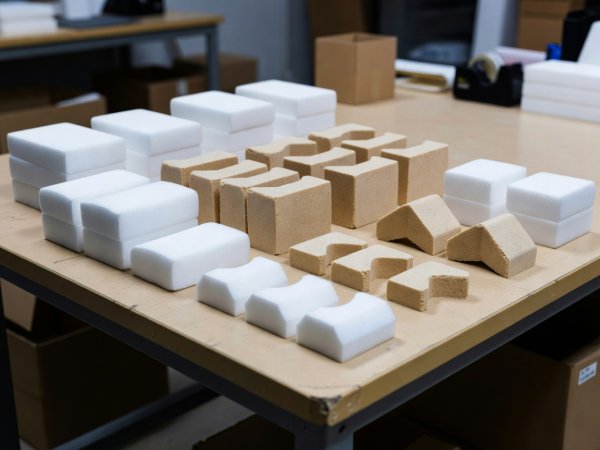
Inserts and partitions add internal structure. A die-cut partition can separate bottles, act as an extra column under stacking loads and keep items from touching. Because inserts and outer box can share the same board, the whole pack can stay in one recycling stream.
Closures, tape and the box maker's certificate
A box fails at its seams as often as its panels. Use tape that suits the board and climate: water-activated paper tape bonds into the fibres and resists tampering, while pressure-sensitive tapes vary widely in grip. Tape the centre seam fully and, for heavy boxes, add an H pattern across edge seams.
In North America, many boxes carry a box maker's certificate on the bottom flap, printing values such as ECT or burst strength. It is a helpful reference when comparing suppliers, but it describes board, not your complete packed system.