Where the water comes from
Moisture reaches a parcel by several routes. Rain and wet ground soak the outside during doorstep deliveries or open-air sorting. Humid air enters boxes in warehouses and trailers, and paper fibres absorb it steadily. Condensation forms when a cold parcel is carried into a warm room: the air touching the cold surfaces drops below its dew point and leaves droplets behind. In sea containers, daily temperature swings can cause repeated condensation that drips from the ceiling, a problem shippers call container rain.
Each route needs a different answer. A rain-resistant outer coating does nothing for condensation inside a sealed pack, and a desiccant cannot keep up with liquid water soaking through a seam.
Measuring absorption and transmission
Two families of tests describe moisture behaviour. The Cobb test, ISO 535 and TAPPI T 441, measures how much water a paper or board surface absorbs in a fixed time. It is useful for comparing coatings and sizing on outer boxes. For films and liners, water vapour transmission rate, often abbreviated WVTR or MVTR, measures how much vapour passes through a material over time. ASTM F1249 is a widely used method for plastic films.
These numbers compare materials, not complete packs. Seams, punctures, folds and tape gaps often let in more moisture than the film itself.
Four layers of moisture defence
Choosing barriers that fit the route
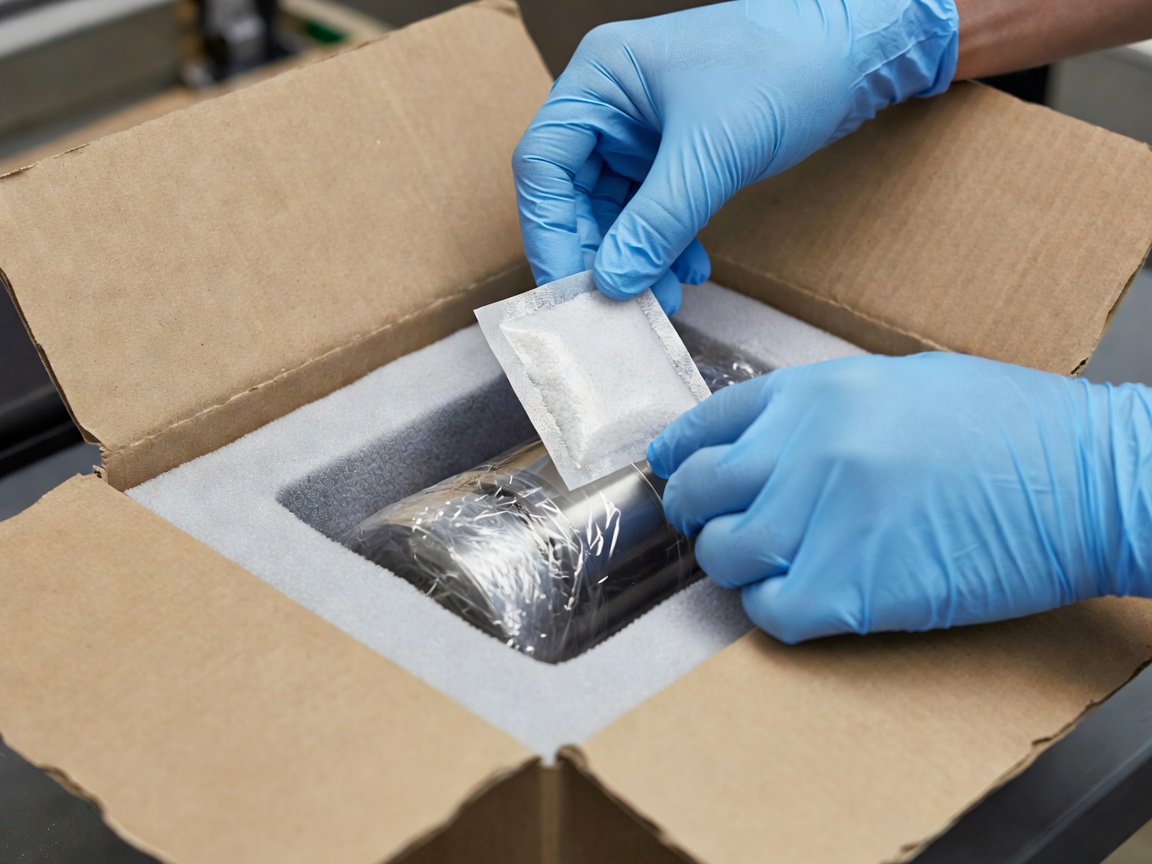
Domestic parcel deliveries mostly need protection from short wet exposures and moderate humidity. A water-resistant outer board or a simple inner bag around sensitive goods usually suffices. Long international journeys, sea freight or slow-moving stock need sealed barrier bags, properly sized desiccants and indicator cards so the receiver can check conditions.
Desiccant quantity depends on the enclosed air volume, the barrier's transmission rate and the expected duration. Standards such as DIN 55473 and MIL-D-3464 define desiccant units, and suppliers provide sizing guidance. Too little desiccant saturates mid-journey; an unsealed bag makes any amount ineffective.
Corrosion-prone metal parts benefit from volatile corrosion inhibitor (VCI) films or papers, which release compounds that form a protective layer on metal surfaces inside a closed pack.
Recyclability without giving up protection
Traditional wax and polyethylene coatings complicate paper recycling. Water-based barrier coatings, mono-material polyethylene liners and paper-based barrier bags aim to keep packs in a single recycling stream. Regulations such as the European Union's Packaging and Packaging Waste Regulation are pushing designs in this direction. Ask suppliers for recyclability evidence specific to your market, and test protective performance after any material switch.
A bench routine for moisture
- List every moisture route on your shipping lanes, including seasonal ones.
- Decide which layers each product needs; not every item needs all four.
- Seal liners fully and avoid punctures from corners or staples.
- Size desiccants for volume and journey length, and keep stock sealed until use.
- Condition sample packs in humid air before compression and drop trials.